
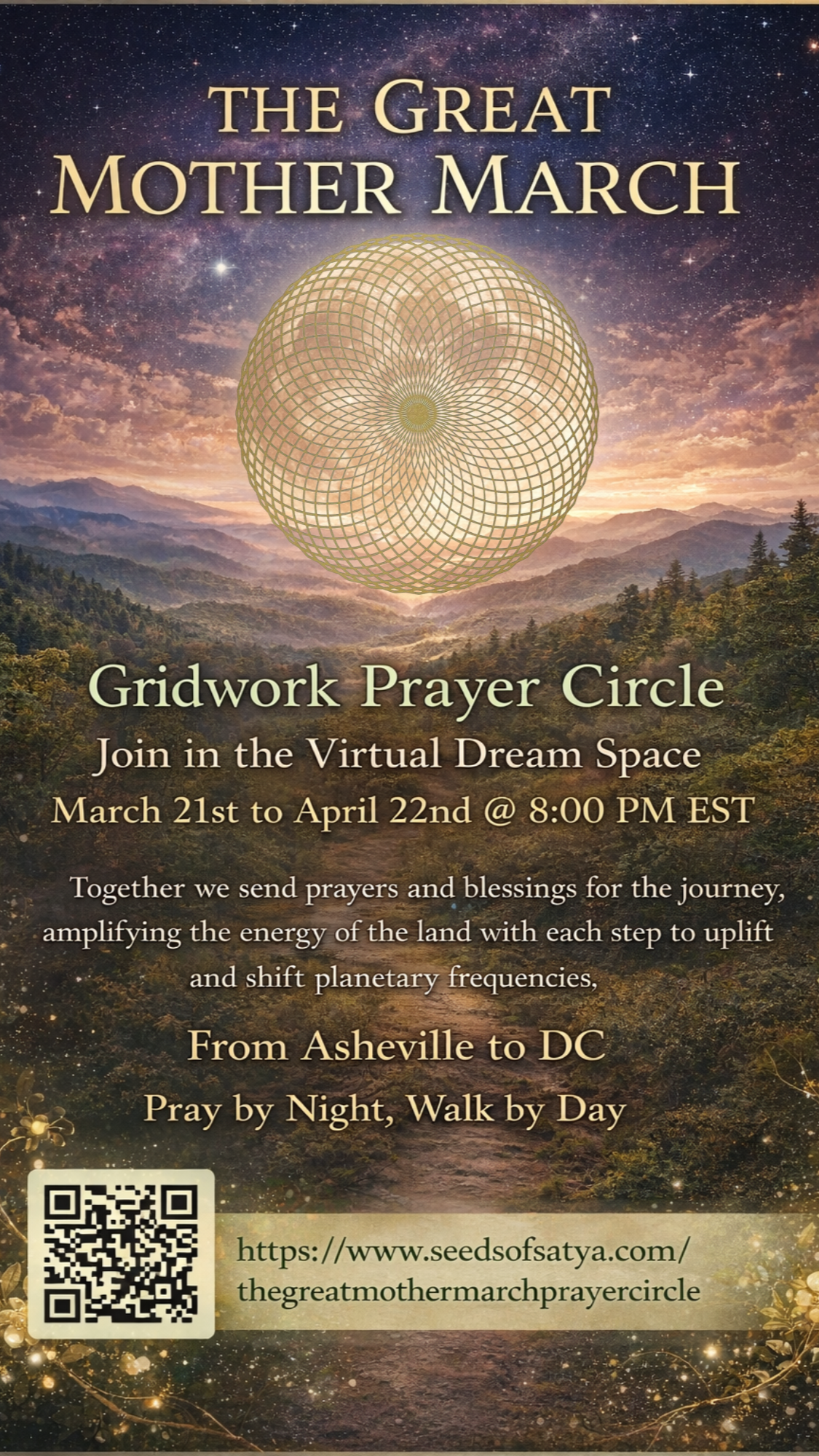
On the Spring Equinox 2026, a sacred moment of balance, The Great Mother March will set forth from Asheville, North Carolina, on a 500-mile pilgrimage to Washington, D.C., arriving on Earth Day, seeding positive change, one step at a time.
Join virtually to support our dear sisters and brothers to ignite light upon their path from all directions, and send prayers of protection and love.
The Earth is a living Sentient being that has its own energetic pattern… like the body, it breathes, pulses, and carries currents of life that we are quietly woven into. A vibratory matrix of light and energy, just as we all are. The earth’s energetic foundation has been burdened, extracted from and suppressed with shadow from old stories and trauma, just as our bodies have been, Both are connected. For we each are like acupuncture needles, as we awaken into higher dimensions of awareness, the earth awakens, and supports us in moving into even higher frequencies, unbinding outdated multidimensional false narratives built from greed and desire to control.
THE EARTH
The Earth has currents, and flows like our blood and nervous system. It has electromagnetic fields, like our heart and brain activity. It has rhythms and pulses, like our breath and heartbeat. The Earth has its own energetic pattern and intelligence that pulses, communicates, and self-regulates through unseen currents that connect everything. In science, this shows up as things like the Schumann Resonances, natural frequencies that are created between the Earth’s surface and the atmosphere. They’re often compared to a kind of “planetary heartbeat.”
In many ancient traditions, this same idea appears as Ley lines (energy pathways across the Earth). Areas such as sacred sites were once placed where energy is strongest. Churches were also purposely placed on areas of land that were notably known to be strongholds of powerful energy by indigenous and native peoples. For they too viewed the Earth as a living conscious system.
GRIDWORK
Just as we awaken our very being, Gridwork is re-awakening of the original network of light that magnetized the elements onto Earth’s manifested body. With intention, presence and awareness, we dissolve old stories and shadow grids, releasing souls who have been lost and trapped in a repetitive narrative of attachment, into higher dimensions of awareness. With intention we raise the original grid of crystalline energy and light into harmonic waves of prosperity, harmony, and deep truth to manifest upon the land, soul of the earth and humanity.
Gridwork is also the work that Jesus did, and the very being who guided me into understanding the power and beauty of sound and light in relationship to the earth, our bodies and the universe, along with a disembodied Cherokee Matriarch whom I received visions from for over a year who guided us to the land we now live on in the Appalachia Mountains.
Five years ago, a dear sister called a virtual circle to help me do gridwork on the land. For there had been so many undeniable interesting experiences where I really needed support. We had a group of 30 women from around the world who attended. I was so grateful, as it was one moment of many that has made a difference in lifting the original light grid. We all saw the dark shadow grids connected through the Appalachia to Washington DC, which are truly connected to each town and state due to history of betrayal and shadow grids purposely created by unconscious forces who attempt to control and manipulate.
This is why I feel called and passionate for us to come together in this way.
Your Presence, Awareness and Magic Is Wanted & Needed.
Together we can lift, light up the path, supporting our Tribe as they walk the miles to DC.
WHAT IS GRIDWORK?
FROM YOUR RESIDENCE TO THE APPALACHIA ONTO WASHINGTON, DC
Where intention meets clarity, and vision meets action.
We are here to do things differently, in truth and with passion.
With Love at the center of it all.
JOIN THE VIRTUAL CIRCLE TO IGNITE LIGHT
-
We will gather virtually at 8pm EST.
From March 21st- April 21st, 2026
We will do prayer for 10 min every night.
Monday, Wednesday and Fridays we will do prayer and Gridwork.
Pray at night, Walk by day.
-
ZOOM…
Kari Rivers is inviting you to a scheduled Zoom meeting.
Topic: THE GREAT MOTHER MARCH PRAYER & GRIDWORK CIRCLE
Time: Mar 23, 2026 08:00 PM Eastern Time (US and Canada)
Every day, until Apr 22, 2026, 31 occurrence(s)
Please download and import the following iCalendar (.ics) files to your calendar system.
Join Zoom Meeting
https://us02web.zoom.us/j/88654548776?pwd=DPC03dTa4kxmdQZWvG2NpSqssSaNiK.1
Meeting ID: 886 5454 8776
Passcode: MAMA
---
One tap mobile
+16469313860,,88654548776# US
+19292056099,,88654548776# US (New York)
Join instructions
-
YOU!
Do you have to know gridwork? NO! Come as you are. Your magic is wanted and needed!
If you would like to say a prayer to open the space for the people walking please sign up here.
If you are an active and experienced gridworker, all are active participants in this experience.
-
We will start at exactly 8pm with a prayer for those walking.
Things you are welcome to bring into ceremony:
Candle light
Water
Instruments: crystal bowls, rattles, drums, etc.
A Crystal you feel called to have near you.
Please make sure your audio is turned off. Unless prompted for shares.
At 8:10 we will start the gridwork session which could last an 45min or longer. It all depends on what is being felt and shown which signifies the degree of presence to shift. And this is also dependent on the amount of those who show up and each persons focus and presence.
Please note the first and last gathering will take longer.
These gatherings will be a guided meditation/journey, there will be prompts with vocal toning. However, you are encouraged to follow your intuition as to what your inner eye is guiding you to do in the moment, as each person has specific and special insights that contribute to the whole.
“When two or more gather then there am I”. - Yeshua
-
Would you like to open us up in a prayer for those walking?
A HEART SONG FOR HUMANITY

THE RIVER IS FLOWING BY KARI RIVERS
May we become a flowing river. surrendering to the truth and magic of all that wants to be known within and all around us.
-
Just as our bodies, land holds memory. Here is a brief history of the townships traveled that we will bring awareness and intention to ignite harmony, love, peace and inner awakening and freedom for all beings.
Join Virtually 8pm EST. 3/21-4/21/26
-
Asheville began as Cherokee homeland, where the Cherokee people lived in deep relationship with the land until their forced removal during the Trail of Tears. Founded in 1797 as a small frontier town, Asheville grew slowly until the late 1800s, when the railroad and figures like George Vanderbilt, builder of the Biltmore Estate, helped transform it into a resort destination known for its mountain air and healing climate. In the early 20th century, it flourished with grand architecture and tourism, then faced economic hardship during the Great Depression before reinventing itself in the late 20th century as a vibrant center for arts, music, and alternative culture, blending its deep Indigenous roots, Gilded Age legacy, and creative spirit into the city it is today.
-
Black Mountain, North Carolina, nestled in the Blue Ridge Mountains, has a layered history: originally Cherokee land revered for its sacred mountains, streams, and connection to spirit. They called it See-noh-ya”—meaning “dark” or “shadowy” mountains. It became a railroad town in the late 1800s, people came to heal Tuberculosis in sanatoriums and health resorts. In the early 1900’s it became a major religious retreat and eventually hosted the largest religious conventions. In 1933 Black Mtn College was created as an experiment for art, music and communal living. In the mid 1900’s-1965 Black Mtn was shaped by segregation. After the college closed, it remained a hub for artists, musicians and story tellers. North Fork Reservoir was flooded to supply water to Asheville. Thousands of acres were taken and submerged.
Overall, Black Mountain through time is a place of to seek healing, meaning, to create and transform.
-
Old Fort, North Carolina is a small town at the eastern edge of the Blue Ridge Mountains near Black Mountain, North Carolina, founded in the 1800s and named after a nearby Revolutionary War era fort. It grew into an important railroad hub, especially along the steep and winding “Old Fort Loops,” which helped trains navigate the dramatic mountain ascent. Today, it is known as a gateway to Pisgah National Forest, drawing visitors for hiking, biking, and waterfalls while maintaining a quiet small town feel. Long before this development, the area was part of the ancestral homeland of the Cherokee people, who traveled these ridgelines and river valleys and held a deep spiritual connection to the mountains as living, sacred landscapes. The surrounding forests, passes, and waterways were not only sources of sustenance but also places of story, ceremony, and connection between worlds, giving Old Fort a deeper history rooted in both Appalachian settlement and enduring Cherokee cultural presence.
-
Marion, North Carolina was founded in 1844 and named after Francis Marion, the “Swamp Fox,” growing into the county seat of McDowell County and an early agricultural and trading hub in the foothills of the Blue Ridge Mountains. With the arrival of the railroad in the late 1800s, Marion expanded through textile mills and industry, shaping its early economy, and in 1929 it became the site of the tragic Marion Massacre, a pivotal moment in U.S. labor history. Long before European settlement, however, this region was part of the ancestral homeland of the Cherokee people, who lived, traveled, and hunted throughout these mountains, holding a deep spiritual relationship with the land, rivers, and surrounding peaks. Nearby sacred landscapes such as Linville Gorge and Grandfather Mountain were understood as places of power, story, and connection to the spirit world. Today, Marion retains its historic small-town character while also standing within this much older Indigenous landscape, serving as a gateway to mountains layered with both Appalachian history and enduring Cherokee cultural significance.
-
Linville, North Carolina began in 1883 as a planned mountain retreat founded by Hugh MacRae and Donald MacRae, designed as an exclusive summer colony along the edge of the Blue Ridge. Nestled near Linville Gorge and the towering Grandfather Mountain, the village grew around landmarks like the Eseeola Lodge and Linville Golf Club, becoming one of North Carolina’s earliest resort communities. Long before this development, however, Grandfather Mountain held deep spiritual meaning for the Cherokee people, who know it as “Tanawha,” often interpreted as a sacred, life-giving presence or “fabulous hawk/eagle spirit.” In Cherokee tradition, the mountain is a place of ancient power, protection, and connection between the earth and spirit worlds, with its rugged peaks and cliffs seen as alive with ancestral presence. This layered history comes with Indigenous reverence which later became a resort development, gives Linville a unique identity rooted both in preserved natural beauty and in the enduring sacred significance of the land.
-
Nestled in the Blue Ridge Mountains of Boone, the area’s history stretches back long before European settlement, when it was part of the ancestral homeland of the Cherokee Nation, who knew the region as part of a vast, spiritually significant landscape of mountains, rivers, and hunting grounds. Though no major permanent Cherokee town stood exactly where Boone is today, the surrounding high country—near features like Grandfather Mountain—held deep cultural importance and was traveled seasonally. European-American settlers began arriving in the late 1700s, and the town was later named after frontiersman Daniel Boone, though he likely never lived in the town itself. Boone developed slowly as a rural mountain community, remaining relatively isolated until the early 20th century when improved roads and the founding of Appalachian State University (established in 1899 as a teachers college) spurred growth. Today, Boone blends its Appalachian heritage, Indigenous history, and educational influence, serving as a cultural and economic hub of North Carolina’s High Country.
-
Todd’s story begins long before it was known as Elk Cross Roads, in a region traditionally used by Indigenous peoples, especially the Cherokee, who lived throughout the southern Appalachian Mountains and relied on rivers like the New River for travel, fishing, and seasonal settlement. By the late 1700s, European American settlers moved into the area, establishing farms and a small crossroads community that grew steadily through the 1800s. Renamed Todd in 1894 after Joseph Warren Todd, the town boomed in the late 19th and early 20th centuries with logging, mining, and the arrival of the Virginia-Carolina Railway, briefly becoming a bustling commercial hub. However, depleted forests, the Great Depression, the loss of rail service, and devastating floods led to its rapid decline by the 1940s, and it eventually lost its charter in the 1970s. Today, Todd endures as a quiet mountain community, its layered history, from Indigenous presence to boomtown rise and rural revival, is still visible in its landscape and historic district.
-
Nestled in the Blue Ridge highlands of Independence, Virginia, the seat of Grayson County, Virginia, the land carries a much older story than its 19th-century founding. Long before European settlers arrived, this region was part of the seasonal hunting and travel grounds of the Cherokee and Saponi peoples, who moved along ancient pathways through the Blue Ridge and gathered near the life-giving waters of the New River—one of the oldest rivers in the world. These mountains were not just terrain, but living, spiritual landscapes where stories, trade, and kinship flowed. By the late 1700s and early 1800s, Scotch-Irish and German settlers began to establish farms and communities, gradually displacing indigenous presence. Independence itself was officially established in 1845 as the county seat, growing as a small hub for agriculture, trade, and local governance. Today, while it remains a quiet Appalachian town, the deeper layers of its history, rooted in both indigenous stewardship and early mountain settlement, continue to shape the spirit of the land.
-
Galax, Virginia is a small city in the Blue Ridge Mountains, established much later than many older towns in Virginia. It was officially incorporated in 1906 and grew quickly because of the railroad and the booming furniture and textile industries. Its location along major rail lines made it a hub for shipping lumber and handmade goods, helping the town develop economically in the early 20th century. Today, Galax is especially known for its traditional Appalachian music and hosts the annual Old Fiddlers’ Convention, one of the oldest and largest events of its kind.
Long before European settlers arrived, the area around present-day Galax was home to Indigenous peoples, primarily the Cherokee and earlier Siouan speaking groups. These communities lived off the land, hunting, fishing, and farming in the rich mountain environment. The region was part of a network of trails used for trade and travel across the Appalachian Mountains. By the 1700s, increasing European settlement pushed many Native groups out of the area through conflict, treaties, and forced migration. The Cherokee, in particular, were eventually displaced further south and west, especially during the period leading up to the Trail of Tears in the 1830s.
So while Galax as a city is relatively young, the land it sits on has a much deeper history tied to Indigenous cultures and early frontier expansion.
-
Hillsville, Virginia, founded in 1790 and incorporated in 1913, is the county seat of Carroll County. It developed as a small courthouse town serving the surrounding farming communities in the Blue Ridge Mountains. Its location along early travel routes helped it become a local center for trade and government.
The town is best known for the 1912 Carroll County Courthouse shooting, a dramatic and violent event during a trial that left several people dead, including a judge and sheriff. It remains one of the most notable courtroom tragedies in Virginia history.
Like much of the region, the area around Hillsville was originally inhabited by Indigenous peoples, including Siouan speaking tribes and later influenced by Cherokee presence. European settlers moved in during the 1700s, gradually displacing Native populations.
Today, Hillsville is known for its annual Labor Day Flea Market and Gun Show, which draws large crowds and continues its tradition as a regional gathering place.
-
Floyd, Virginia is a small town in the Blue Ridge Mountains and the county seat of Floyd County, which was formed in 1831 from parts of neighboring counties. The town itself developed as a rural farming and trading center, with agriculture especially livestock and crops, playing a major role in its early economy.
Before European settlement, the area was used by Indigenous peoples, including Siouan-speaking groups and later Cherokee, mainly for hunting and travel through the mountains. By the late 1700s, settlers of European descent began moving into the region, gradually displacing Native populations.
In the late 19th and early 20th centuries, Floyd remained relatively isolated compared to railroad towns nearby, which helped preserve its rural character. Today, it’s known for its strong Appalachian culture, especially traditional music, crafts, and events like the Friday Night Jamboree at the Floyd Country Store.
-
Ferrum, Virginia is a small community in Franklin County, founded in the late 1800s. Its name comes from the Latin word for iron, reflecting early hopes that the area would develop around iron mining, though that industry never became very large there.
The community grew as a rural farming area, with agriculture playing the main role in its economy. In 1913, Ferrum became home to Ferrum College, which started as a school connected to the Methodist Church and helped shape the town’s identity and growth.
Before European settlement, the region was used by Indigenous peoples, including Siouan-speaking groups and later Cherokee, mainly for hunting and travel. As settlers moved in during the 1700s and 1800s, Native populations were pushed out.
Today, Ferrum remains a quiet rural community, known for Ferrum College and its connection to Appalachian culture and history.
-
Rocky Mount, Virginia was established in the late 1700s and became the county seat of Franklin County in 1786. It developed as a center for government, trade, and agriculture in the region, with nearby farms producing tobacco, corn, and livestock.
Before European settlement, the area was used by Indigenous peoples, including Siouan-speaking tribes and later Cherokee, mainly for hunting and travel routes through the Blue Ridge foothills. As settlers moved in during the 1700s, Native populations were gradually displaced.
In the 1800s and early 1900s, Rocky Mount grew with the expansion of roads and rail connections, helping local businesses and industry. It became known for its role in agriculture and later small manufacturing.
Today, Rocky Mount is a small town that serves as a commercial and administrative hub for Franklin County, while still reflecting its rural Appalachian heritage.
-
Timberlake, Virginia, unlike nearby Lynchburg, is not an incorporated city or town, so its history is less about formal founding events and more about gradual suburban development.
Early history (1700s–1800s):
The Timberlake area, located in Campbell County just southeast of Lynchburg, was originally rural farmland. Like much of central Virginia, it was settled in the 18th century by European colonists, with agriculture—especially tobacco—driving the local economy. Enslaved African Americans made up a significant portion of the labor force on these farms prior to the Civil War.19th to early 20th century:
After the Civil War, the area remained largely agricultural, with small farms and scattered rural communities. There was no distinct “town” of Timberlake at the time—just countryside connected economically and socially to Lynchburg and other nearby communities.Mid-20th century suburban growth:
Timberlake began to take shape in the mid-1900s as Lynchburg expanded outward. Improvements in roads and increased automobile use made it easier for people to live outside the city and commute in for work. Residential subdivisions began to replace farmland, marking the area’s transition from rural to suburban.Late 20th century to present:
By the late 1900s, Timberlake had become a recognizable suburban community. It was designated as a census-designated place (CDP) by the U.S. Census Bureau, meaning it has defined boundaries for statistical purposes but no independent municipal government. The area continued to grow with housing developments, shopping centers, and schools serving the expanding population.Today, Timberlake is considered part of the Lynchburg metropolitan area. It’s primarily residential, with commercial corridors along roads like Timberlake Road (U.S. Route 460), and reflects the broader pattern of suburbanization seen across the United States in the late 20th century.
-
Lynchburg, Virginia. often called the “City of Seven Hills”,, has a long and layered history tied to transportation, industry, religion, and education.
Early beginnings (1700s):
The area was originally inhabited by Native American tribes, including the Monacan. In 1757, John Lynch established a ferry service across the James River, which became a key crossing point for travelers and trade. The settlement that grew around this ferry was called “Lynch’s Ferry,” and in 1786 it was officially incorporated as the town of Lynchburg.Growth and economy (1800s):
Lynchburg developed into a major tobacco trading and manufacturing center in the 19th century. Its location along the James River—and later its access to canals and railroads—made it a transportation hub. By the mid-1800s, it was one of the wealthiest towns in Virginia.Civil War era (1860s):
During the American Civil War, Lynchburg served as an important Confederate supply and hospital center. In 1864, Union General David Hunter attempted to capture the city but was repelled by Confederate forces under General Jubal Early in the Battle of Lynchburg. The city was spared major destruction, allowing it to recover more quickly than many Southern cities.Post-war and industrial era (late 1800s–early 1900s):
After the war, Lynchburg rebounded as a center for tobacco, ironworks, and manufacturing. The arrival of multiple railroads strengthened its position as a regional economic hub. However, like much of the South, it also experienced the effects of segregation and Jim Crow laws during this period.20th century changes:
The tobacco industry declined in the mid-20th century, leading to economic shifts. Lynchburg diversified into other industries, including nuclear technology and manufacturing. It also became known for higher education, with institutions like Randolph College (founded 1891), the University of Lynchburg, and later Liberty University (founded 1971).Civil rights and modern era:
Like many Southern cities, Lynchburg experienced social change during the Civil Rights Movement. Schools and public facilities were gradually integrated. In recent decades, the city has worked to revitalize its downtown and riverfront areas while preserving its historic architecture.Today:
Lynchburg is known for its mix of historic charm and modern development, its colleges and universities, and its scenic location along the James River. Its history reflects broader themes in American history—colonial expansion, industrial growth, the Civil War, and ongoing social change. -
Early history (1700s):
The area that is now Amherst County was originally inhabited by Native American tribes, including the Monacan people. European settlers began arriving in the early 18th century, primarily Scotch-Irish and English farmers. Amherst County was officially formed in 1761 from Albemarle County and was named after Jeffery Amherst, a British Army officer.Colonial and Revolutionary era:
During the colonial period, Amherst was largely rural, with tobacco farming as a major economic activity. Residents of the county participated in the American Revolution, supporting independence from Britain.19th century (growth and Civil War):
In the 1800s, agriculture remained central, but the region also benefited from improved transportation. The James River and Kanawha Canal and later the railroad helped move goods and people through the area.During the Civil War (1861–1865), Amherst County was part of the Confederacy. While no major battles were fought directly in the county, it played a supporting role by supplying troops and resources.
Late 1800s–early 1900s:
After the war, Amherst slowly rebuilt its economy. The arrival of the railroad encouraged small industries, including milling and timber. The town of Amherst became the county seat, replacing the earlier courthouse village of Five Oaks.20th century to present:
Amherst remained largely rural but gradually modernized with better roads, schools, and infrastructure. The county developed a mix of agriculture, manufacturing, and small businesses. Its proximity to Lynchburg has influenced its growth and economy.Today, Amherst is known for its scenic location near the Blue Ridge Mountains, historical landmarks, and quieter rural character, while still being connected to nearby urban areas.
If you want, I can go deeper into specific parts—like Civil War activity, notable people, or historic landmarks in Amherst.
-
Charlottesville, Virginia, was established in 1762 in Albemarle County along a key colonial trade route and named after Queen Charlotte. Before European settlement, the area was inhabited by the Monacan people, who were later displaced. The city grew as a tobacco trading center and gained lasting significance through Thomas Jefferson, whose nearby estate, Monticello, and founding of the University of Virginia in 1819 helped shape it into an intellectual hub. During the Civil War, it served as a hospital center, and in the 20th century it became a focal point in the struggle over segregation and civil rights. Today, Charlottesville is known for its rich historical layers, blending early American heritage with ongoing cultural and social evolution
-
-
-
-
-
-